
How to Calculate Coffee Quantities for Events

Table of Contents
How to Calculate Coffee Quantities for Events: The Basics
Step 1: Estimate Coffee Drinkers by Percentage of Guests
Step 2: Calculate Coffee Per Person for an Event
Step 3: Convert to Cups and Gallons
Understanding Coffee Brewing Ratio for Large Groups
How Much Coffee for 200 Guests: A Worked Example
Using an Event Coffee Calculator and Adjustment Factors
Common Mistakes to Avoid When Planning Event Coffee
Frequently Asked Questions
Last Updated: October 13, 2026
How to Calculate Coffee Quantities for Events: The Basics
Getting coffee quantities right matters: too little and guests leave thirsty, too much and you waste money. The trick is knowing how to calculate coffee quantities for events with a simple formula based on guest count and expected consumption.
At Thunderbird Coffee, we help event planners nail this calculation every time. Whether you're hosting 50 people or 500, the math stays the same, only the assumptions change.
Step 1: Estimate Coffee Drinkers by Percentage of Guests
Not every guest drinks coffee, and the percentage varies with timing and crowd.
Start by picking an expected percentage. An 8 a.m. corporate breakfast might see 70-80% of guests drinking coffee; a 2 p.m. event drops to 30-40%; an evening wedding reception might be just 15-25%.
Here's a quick breakdown by event type:
Morning events (7-10 a.m.): 70-80% of guests drink coffee
Late morning (10 a.m.-12 p.m.): 60-70% drink coffee
Lunch events (12-1 p.m.): 40-50% drink coffee
Afternoon events (2-5 p.m.): 30-40% drink coffee
Evening events (6 p.m.+): 15-25% drink coffee
Timing matters: morning guests need their fix, while evening guests have already had theirs or are winding down.
Crowd matters too: corporate events with tired professionals might skew toward 75%, a relaxed festival 50%, a wedding of non-coffee drinkers 25%.
Pro Tip Ask your event host about their guest list. Are they early risers? Do they work long hours? Are there dietary restrictions or preferences you should know about? These details shift your percentage up or down.
Step 2: Calculate Coffee Per Person for an Event
Multiply guest count by that percentage to get coffee drinkers.
Example: 200 guests × 60% = 120 coffee drinkers.
Now estimate servings per person: most guests drink one cup, some two. On average, plan for 1.2 to 1.5 servings per coffee drinker.
The range depends on service length: a 30-minute service sees fewer refills, a 3-hour event more.
For a quick event: use 1.2 servings per person. For a longer event: use 1.5 servings per person.
Worked math: 120 coffee drinkers × 1.3 servings = 156 total servings needed.
Key Takeaway Total servings = (Guest count × Coffee drinker %) × Servings per person
Step 3: Convert to Cups and Gallons
Standard cup sizes:
Small: 8 fluid ounces
Medium: 12 fluid ounces
Large: 16 fluid ounces
Most events serve medium cups (12 oz).
The conversion: 1 gallon = 128 fluid ounces, or approximately 10-11 medium cups (12 oz each).
So 156 servings ÷ 10.5 cups per gallon = 14.9 gallons, or roughly 15 gallons of brewed coffee.
Watch Out This assumes you're serving straight coffee. If you're offering espresso drinks (lattes, cappuccinos, americanos), the math changes because each drink uses less brewed coffee and more milk or water. Mobile espresso services like Thunderbird Coffee handle this differently; we brew espresso shots and add milk or water per drink, so we work backward from servings instead of gallons.
Quick reference for common guest counts:
Guest Count | Coffee Drinkers (60%) | Total Servings (1.3x) | Gallons Needed |
50 | 30 | 39 | 3.7 |
100 | 60 | 78 | 7.4 |
150 | 90 | 117 | 11.1 |
200 | 120 | 156 | 14.9 |
300 | 180 | 234 | 22.3 |
Understanding Coffee Brewing Ratio for Large Groups
The coffee-to-water ratio determines strength and is the number most event planners get wrong when scaling up, get it wrong and your coffee tastes weak, bitter, or inconsistent.
The baseline ratio: 1 part coffee grounds to 16-18 parts water by weight. That range is the widely used starting point for batch brewing. A 1:16 ratio produces a fuller, stronger cup; 1:18 produces a lighter one. For events where guests add milk, sugar, or cream, lean toward 1:16 so the coffee still tastes like coffee after doctoring.
Why weight beats volume at scale: A tablespoon of coarse grounds and a tablespoon of fine grounds don't weigh the same, so volume scoops drift up to 15-20% off target, tolerable in small batches, but a noticeably weak or bitter urn at 15 gallons. Weigh if you can; otherwise use the volume shortcut below.
Volume shortcut (no scale): 1 tablespoon of ground coffee per 6 fluid ounces of water. This approximates the 1:16 ratio closely enough for planning.
Scaling up, the math for 15 gallons:
15 gallons = 1,920 fluid ounces
1,920 ÷ 6 = 320 tablespoons of ground coffee
320 ÷ 16 = 20 pounds of ground coffee
The catch: Batch brewing does not scale linearly. Three things change:
Grind size. Large batch brewers need a coarser grind than drip machines: too fine clogs the bed and extracts bitter compounds, too coarse leaves you with brown water.
Brew time and temperature. A 1-gallon batch might finish in 4-6 minutes, while a 3-gallon batch on the same equipment takes 10-15 minutes and the water temperature drops. Below roughly 195°F, extraction stalls and coffee tastes flat.
Holding time. Coffee held on a burner degrades fast: quality holds about 20-30 minutes on a heat source and up to 2 hours in a sealed, preheated airpot or thermal urn. Past that, it tastes scorched or stale.
Volume Needed | Typical Equipment | Notes |
Up to 3 gallons | 1-2 airpots (2.5-3 L each) or a 60-cup urn | Good for 30-60 guests |
3-6 gallons | 2-3 airpots or a 100-cup urn | Stagger brewing so one is always fresh |
6-12 gallons | 2-3 large urns plus a backup brewer | Assign someone to replenish |
12+ gallons | Multiple brewers or a mobile espresso setup |
|
The replenishment rule: Never let an urn run empty before starting the next batch. A 100-cup urn takes 30-45 minutes to brew and heat, so during a 15-minute morning rush the second urn must already be brewing before the first empties.
Watch Out This section assumes you are serving straight brewed coffee. If you are offering espresso drinks (lattes, cappuccinos, americanos), the math changes because each drink uses a small volume of concentrated espresso plus milk or water. Mobile espresso services like Thunderbird Coffee work backward from servings rather than gallons, pulling shots to order. Grounds (tablespoons) = Total fluid ounces ÷ 6. Pounds = tablespoons ÷ 16. Always round up and add a 10-15% buffer.
How Much Coffee for 200 Guests: A Worked Example
Let's walk through a 200-person corporate breakfast, 8 a.m. to 9:30 a.m.
Step 1: Estimate drinkers
200 guests, morning event = 75% drink coffee
200 × 0.75 = 150 coffee drinkers
Step 2: Calculate servings
90-minute event = 1.4 servings per person
150 × 1.4 = 210 total servings
Step 3: Convert to gallons
210 servings ÷ 10.5 cups per gallon = 20 gallons of brewed coffee
Step 4: Calculate grounds
20 gallons = 2,560 fluid ounces
2,560 ÷ 6 = 426 tablespoons = 26.6 pounds of ground coffee
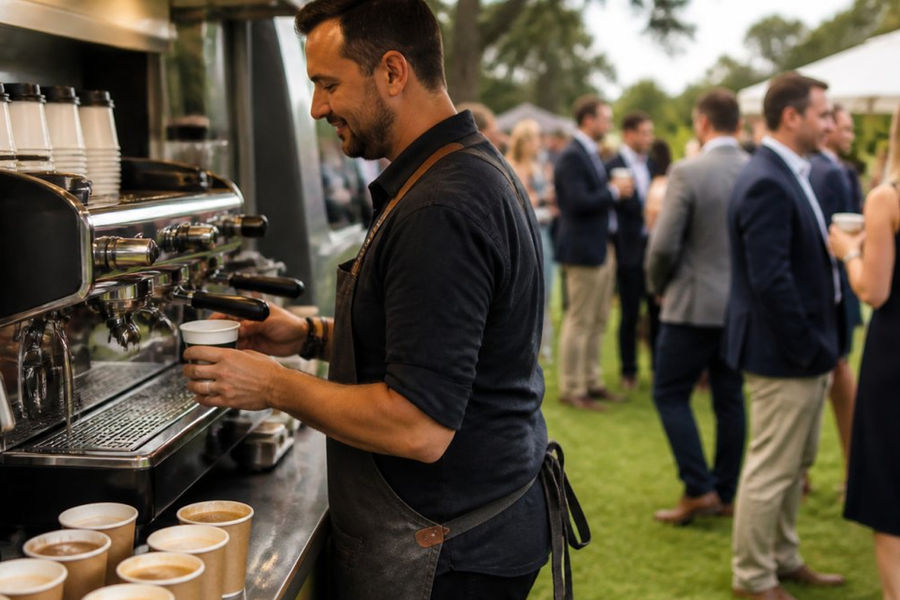
In practice: You'd need 2-3 large urns or a mobile espresso bar with multiple group heads to serve 150 people in 90 minutes without long lines. Thunderbird Coffee handles this with professional equipment and trained baristas.
Add a buffer: Always brew 10-15% extra, for 20 gallons, brew 22-23. Leftover coffee is better than running short.
Using an Event Coffee Calculator and Adjustment Factors
The base formula gives you a starting number. Real events need adjustment, and the biggest variable most guides ignore is when coffee gets consumed, not just how much.
Build the calculator in five columns in a spreadsheet and reuse it:
Column | What Goes In | Example |
A | Guest count | 200 |
B | Coffee drinker % (by time of day) | 75% |
C | Servings per drinker (by duration) | 1.4 |
D | Adjustment multiplier (see below) | 0.9 |
E | Total servings = A × B × C × D | 189 |
Step 3, Adjustment multipliers. Apply these on top of the base:
Cold weather: ×1.05 to ×1.10
Hot weather: ×0.90 to ×0.95
Formal corporate event: ×1.10 to ×1.15
Casual or outdoor festival: ×0.90 to ×0.95
Tea, hot chocolate, or cold brew also offered: ×0.80 to ×0.85
Barista service instead of self-serve: ×1.05 to ×1.10 (guests order drinks they would not make themselves)
Decaf offered: no change to total; it shifts the split, not the volume
Worked scenario, all-day conference, 300 attendees, 8 a.m. to 4 p.m.:
Morning block (8-10 a.m.): 300 × 0.75 × 1.3 = 293 servings
Midday block (10 a.m.-1 p.m.): 300 × 0.55 × 1.3 = 215 servings
Afternoon block (1-4 p.m.): 300 × 0.40 × 1.5 = 180 servings
Total: 688 servings
At 12 oz per serving, that is 8,256 fluid ounces, or about 65 gallons across the day. That is not one giant batch, it is roughly 22 gallons in the morning, 16 at midday, and 27 in the afternoon, brewed in waves so nothing sits out.
Planning for peak demand. Consumption is not even, most events see 40-50% of daily coffee volume in the first 45 minutes.
Translating volume into serving stations. A single self-serve station serves about 75-100 guests per hour; above that, add or staff a second. For 300 attendees in a morning rush, two stations minimum, three if the room is large.
Waste and contingency planning. Brew 10-15% more than your calculated total. Leftover coffee is cheaper than a shortage, but excess gets dumped. Track actual consumption at your first few events and adjust your multipliers to match your real audience.
Pro Tip After each event, log three numbers: guests, gallons brewed, and gallons poured out. After two or three events, your multipliers will be calibrated to your actual crowd, and the calculator becomes far more accurate than any generic rule of thumb.
Common Mistakes to Avoid When Planning Event Coffee
Mistake 1: Forgetting refills. One serving per person assumes no refills. But 30% of coffee drinkers want a second cup, especially at longer events. Use 1.3-1.5 servings per person, not 1.0.
Mistake 2: Underestimating morning events. Tired professionals at 7 a.m. need coffee, use 70-75%, not 50%.
Mistake 3: Overestimating evening events. A 6 p.m. reception doesn't need breakfast-level coffee, use 20-25%, not 50%.
Mistake 4: Ignoring brewing time. Batch brewing 20 gallons takes 30-45 minutes, so start 1.5 hours before guests arrive. Mobile espresso services arrive ready to serve immediately.
Mistake 5: Forgetting about peak demand. Guests don't drink evenly, most grab coffee in the first 15-20 minutes. Plan equipment and staff for that spike, not the average.
Mistake 6: Choosing the wrong serving method. Thermal urns keep coffee hot for 2-3 hours; beyond that, quality drops. For events over 3 hours, use a mobile espresso setup where coffee is made fresh throughout.
Mistake 7: Skipping the buffer. Always brew 10-15% extra. It's cheap insurance against running short or needing refills sooner than expected.
Calculating coffee quantities for events comes down to three numbers: guest count, consumption percentage, and servings per person. Multiply them, convert to gallons, add a buffer.
But the real variable is your service setup. Batch brewing works for small events. For larger gatherings, especially corporate events, weddings, and festivals, a mobile espresso service can provide fresh coffee and keep guests happy.
Frequently Asked Questions
How many cups of coffee should I plan per guest at an event?
A standard estimate is 1 to 1.5 cups per person, assuming 60-75% of your guests will drink coffee. For a 100-person event, plan 60-75 cups. Adjust upward for morning events or outdoor venues where guests stay longer, and downward for evening receptions. Consider your guest demographics, corporate events typically see higher coffee consumption than evening celebrations.
How do I calculate the amount of brewed coffee for an event?
Start with your guest count, estimate the percentage who will drink coffee (typically 60-75%), then multiply by cups per person (1-1.5). For example: 150 guests × 70% × 1.25 cups = 131 cups needed. Convert to gallons by dividing by 16 (since 16 cups = 1 gallon). Always add 10-15% extra for refills and contingency.
What is the coffee brewing ratio for large groups?
The standard coffee-to-water ratio is 1:16 (1 part coffee grounds to 16 parts water by weight). For batch brewing at events, use 1 ounce of ground coffee per 16 fluid ounces of water, or approximately 2 tablespoons per 6 ounces of water. This produces a balanced, full-bodied cup suitable for serving multiple guests throughout your event.
How much extra coffee should I plan for an event?
Add 10-15% to your calculated total for refills, spillage, and guests who arrive late or want seconds. For a 150-guest event requiring 120 cups, plan for 132-138 cups total. For longer events (4+ hours), consider adding 20% to account for sustained demand and multiple servings per guest throughout the day.
Book Today
Comments